EXPLORE THE FULL IDEA
One campus. Many possible gains.
Explore the 100–200-mile regional vision: three hospital phases, 600–700 eventual beds, advanced neurological care, 300–500 workforce homes and the potential impact across the Valley and California.
Read the full campus guide →A care proposal starts with people
A patient’s journey does not begin at a hospital door. The practical questions include getting to an appointment, finding appropriate services and sustaining the workforce that provides them. The Lyra Regional Health Center concept considers these questions together.
This is a research direction, not an announced construction project. No operator, site, capacity or financing is confirmed. The first test is whether a defined care need justifies a new service compared with better access to existing providers.
Start with the regional vision, then deliver useful stages
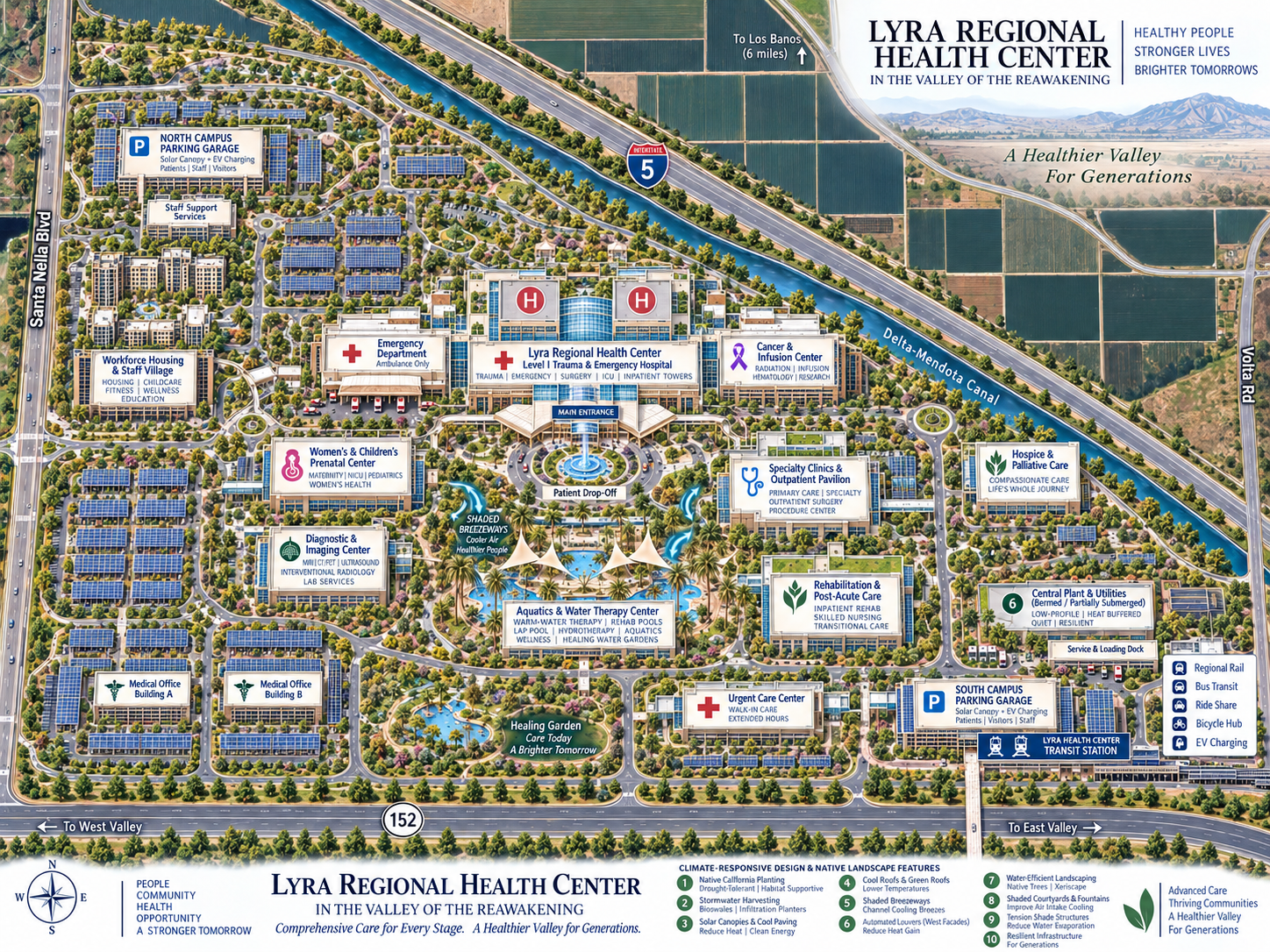
The restored master plan proposes roughly 200 acres, a 150–200-bed first hospital growing to 350–450 and ultimately 600–700 beds, and 300–500 workforce homes. Bed and housing counts are cumulative planning targets. The referral ambition reaches 100–200 miles, supported by local care and transport.
Advanced neurological care—including stroke intervention, neurosurgery, a neuro ICU and rehabilitation—is a core development priority. The full campus guide now explains the phases, family lodging, high-acuity services and potential Valley-wide and statewide benefits.
Early clinics, housing, training and transport can deliver value while the hospital develops. Compare the plan with improvements to existing care and use demand, staffing, outcomes and funding to decide when to expand.
Care and connections belong in the same conversation
The companion Western Valley Connections idea asks which trips are missing or unreliable. That research could help test how patients and staff reach a future service. It does not establish a rail line or passenger service.
Regional planning resources are a starting point, not evidence of endorsement. The next useful work is a needs-and-options brief with an operator and affected residents.
What would change our mind?
An independent review might find demand too small, recruitment too difficult or a lower-cost intervention more effective. Those are useful findings. The goal is better care; the idea page keeps alternatives and unresolved questions visible.
The next decision
Define the service gap and identify an operator willing to test it. Publish the baseline and comparison criteria before selecting a building or bed count.
Sources & reading
- MCAG · Official regional planning and agenda resourcesOrganizational resources checked September 11, 2026. No commitment to these proposals is established.
Concept development: Kevin G. Founding text prepared with AI assistance for editorial review. These proposals explore possibilities; they do not announce approved projects.
Published revision history
Version 2 · 2026-09-21
Preserved before the regional master-plan restoration
Version 2 · 2026-09-21
Restored at the owner’s request: regional reach, cumulative hospital and housing phases, advanced neurological care, high-acuity impact and corrected financial-example scope.
Version 1 · 2026-09-11
Initial concept brief; editor approval pending public launch
HELP SHAPE THE NEXT IDEA
What should we explore next?
Send an idea, a thoughtful challenge, a correction or experience from your community. Tell us what could improve, who it would help and what it would take.
How to contribute →
THE CONVERSATION
What would make this idea better?
Share a question, a local perspective, or a way to improve the proposal. Thoughtful disagreement is welcome.
Loading comments…